
“Facts alone can’t save the world. Hearts can. Hearts must. We’re working to make sure that hearts do.” –– Carl Safina
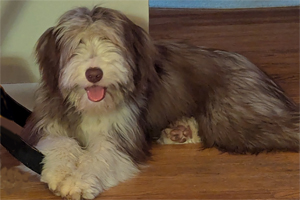
In March, I went to my first AKC dog show with my neighbor Sheryl who breeds, trains, and shows bearded collies, the long haired Scottish herding beauties. We took Sheryl’s nine-month-old puppy Disa. It was the pup’s first show too.
In the past, Sheryl has worked with a pet communicator to try to better understand her dogs and their needs. The pet communicator was at the show, and Sheryl signed up Disa for a session. I know many have a healthy skepticism about such activities, but I have always been open to the paranormal and was curious as to what Disa would have to say.
Sheryl’s main interest in working with the pet communicator was to learn if Disa was comfortable being shown with all that entails. Disa communicated that she was open to the idea but found it a lot to process. She was like the new kid on the first day of school, shy, quiet, just taking it all in, trying to figure out how and where to fit in at a show with 3600 other dogs.
HOW VS. WHAT
Disa lives with four dogs, including her four-legged aunt, Finney. The two regularly roughhouse together, chew on one another, chase each other. Lately, when Finney is lying down, Disa has taken to pulling her aunt across the floor by grabbing a mouth full of Finney’s long dark head hair –– Disa is a very strong pup. By doing so, she breaks off several inches of Finney’s hair, which does not bode well for entering Finney in future shows. Sheryl had the pet communicator tell Disa to stop pulling Finney by her hair. Disa’s response? But how else am I to pull her?
Disa, of course, missed the point of the request, which was to stop dragging Finney around, not do it some other way.
Often, we two-leggeds also miss the point. When I do, I can see the ways in which I am often obsessed with my own wishes –– to be happier, more secure, better understood, even loved. That is all I can see. The how. I miss what matters more, that the true questions of my life are not so much ones of how but what.
What I am to be about is often a question I do not consider.
THE HEART OF THE MATTER
How justifies our actions. What, on the other hand, cuts to the heart of the matter.
As an example, it is easy for me to quietly claim superiority when I see others struggle from the choices they have made, thinking I would never make those choices. In other words, their struggles are due to poor decisions. But then I look at all the bad choices I have made, the stupid things I have done, the times I was inconsiderate, broke my word, or took what was not mine. I try to tell myself that what I have done is different from what others do. But if I am honest, I know I am no different than anyone who has chosen poorly.
While I would never drain money from a stranger’s bank account, once when young I stole postage stamps from my mother’s office drawer and then lied about it. While I would never fabricate degrees I did not earn on a resume, I did sneak open my physical science book for answers during a high school exam. While I could never endorse rejecting immigrants because they come from a land where people have darker skin, I have extended invitations to those visiting this country and then never followed up.
A BRIDGE
Seeing how I am no different makes it easier for me to shift from the how to the what.
 I find a bridge to this transition in the teachings of a Buddhist monk. Thich Nhat Hanh tells the story of identifying with the pirates who attacked the Vietnamese people as they fled in boats from their homeland to escape the coming Communist regime. That a Buddhist monk devoted to peace would make such an identification may seem strange at first glance. But at the heart of Buddhism is the recognition of non-duality. There is no “them” –– only “us.” Hanh sees that if he had been born into the same situation as the pirates, he too would have been a pirate.1
This story helps me see the way in which my lack of respect for others who make poor choices is rooted in a judgment that is off base. Such judgement saves me from any meaningful self-examination and prevents me from looking at the larger picture, keeping me safe and smug in my own little world.
THE WORK
I have been working recently on trying to embrace those parts of me that I wish to reject, that I deem unacceptable, unlovable. Perhaps this work is coming to some fruition because last night I dreamt I had fallen in love with a national political leader whom, in my non-dream reality, I wish would just take his money and go away.
I do not claim to be an expert on dreams, and often find them confusing, but, as I can, I try to understand what my unconscious may be telling me through dreams. And I recognize that any part of a dream, whether it is a person, animal or thing, is a part of myself. So, in the case of last night’s dream, could my love for this politician in my dream be my growing ability to accept those parts of me that I wish weren’t there?
I think of Judy Todd’s insightful contribution to last month’s edition, about how she learned to embrace her younger self who made so many mistakes. Am I finally doing what my fellow pilgrim learned years ago?
CRACKING OPEN
And what does this have to do with a puppy not understanding that perhaps yanking her aunt across the floor by the hair of her head is not a good thing to do? I think young Disa has yet to recognize what she should be doing rather than how she should be doing it.
And what does that tell me, who longs to address the what? It’s not how can I be happier, but what is it to be happy. It’s not how to be more secure, but what security means. It’s not how can I get people to understand, but what it would be like to be understanding. It’s not how am I to be loved, but what my love can bring to others.
A re-orientation from how to what may be something Disa may never learn, but hopefully I will, cracking my world open, creating new paths for me to explore, pointing me in a new direction. Not yanking, not being yanked, but walking into a whole new way of being.
FOR REFLECTION: Consider the times you may have been more focused on the how versus the what? Could you (can you) set aside the “hows”? More importantly, can you name the “whats” in your life, that is, what you are to be about, rather than how you are to get what you want? By prioritizing what over how, can you see new possibilities, new ways to move forward into a more meaningful way of living?
1Thich Nhat Hanh, Being Peace (Berkeley, CA: Parallax Press, 2005), 65-66.
Top image: Photo of Disa by Patricia Sherwood
Midtext image: Pixabay/Rabeebur Rahman
Side image: Pixabay/Avelino Calvar Martinez
