
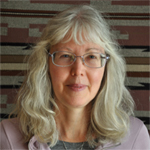
 Audrey Hackett lives in the Berkshires of Western Massachusetts with her husband and dog. A returnee after twelve years of living in Yellow Springs, Ohio, she is reacquainting herself with the shadowy beauty of the northern woods. She holds an MFA in Poetry from Vermont College of Fine Arts and currently works in communications and development for a local nonprofit. Recent poems can be found here and here.
What past event do you often reflect upon, and how did that event change you?
I grew up in the suburbs of northern Virginia in the 1980s, a fast-changing time. I loved the woods and stream near my home, still full of the mysteries. At four, I learned that the blue flowers had names, as I had a name: chicory, or chickweed. At eight, I followed the stream as far as I dared, crayfish and tin cans glinting at my feet. At ten, I established a tree-climbing route. The suburban wilds claimed me. And sorrow claimed me as well, because to love the natural world is to be alive to the pain of its ongoing destruction. That early experience of place –– a place undergoing erasure –– was formative. It helps me love in the face of change and loss.
How does your work add to the quality of your life?
At best, my work as a writer and reader clarifies, intensifies, and extends my experience of living. When I read, from Jane Kenyon, “the soul’s bliss / and suffering are bound together / like the grasses,” I shudder in recognition. When I read, from Jane Austen, that a character has learned merely to seem polite rather than truly be so –– to possess a polite heart –– I catch myself in the mirror and vow to do better. And when I read, from Denise Levertov, of “the long stem of connection” between the “wily mud” and the “lotus cup,” I sense a truth that nourishes both life and art. Writing, I try to stay alive to the subtle ways in which life and imagination feed and enlarge each other.
Tell us a story you would like to share with the world.
This is a story still unfolding. I am in the midst of settling the estate of a long-ago English professor who reached from the other side, as it were, to summon myself and another former student to this task. Meeting for the first time, she and I have set our hands to the intimate work of sorting, sifting, deciphering, deciding, dispersing, and releasing. It is sacred, sad, and often baffling work. My experience so far carries a solemn note –– a warning –– about the power of language and literature. Books can be walls as well as portals. The delicate living connection (Levertov’s “long stem”) must be maintained between the word and the world. Literature must enter the mind through the door of the heart.
Author photo: Courtesy of author
Side bar image: Pixabay/Edar
