
 “My life is full of mistakes. They’re like pebbles that make a good road.” –– Beatrice Wood
Fourteen months ago, my niece’s mother, my brother’s first wife, died suddenly. She left behind a suburban home full of all the things one accumulates when living in one space for thirty plus years. Since I coordinate my church’s annual rummage sale, I told my niece if any of her mother’s possessions were left over after she and her mother’s brothers and sisters took what they wanted, I would take them for the next sale.
Early in June, my niece called me to say I could have what was left in her mother’s home.
I remember walking into the house and thinking oh no. I anticipated seeing a few items here and there that I could box up in a dozen plastic bins and store in my basement until the next sale. What I saw were rooms of furniture, kitchen counters full of dishes and cookware, closets of clothes and linens, along with bedding and rugs, lamps and art, and so much memorabilia, as well as a basement with boxes and boxes of holiday decor –– for every season. I took a breath and called my niece. “How about I just do an estate sale?”
The next four weeks, I was at my ex-sister-in-law’s house almost daily. I recruited neighbors and church friends to help sort and price. I invited Alyssa, a friend who owns a local resale shop, to come in pre-sale and take what she thought she could sell.
She played a role in what follows.
THE VALUE OF BUNK BEDS
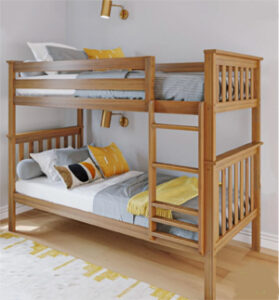 Among the furniture that I had for sale was a set of bunk beds. A week before the sale, Alyssa called. A woman had just been in her shop looking for bunk beds for the teenage kids she and her husband wanted to foster. Alyssa gave me the woman’s phone number.
The beds were a quality set, solid oak. Alyssa thought I should ask $150 for the furniture, which would be a good deal she said. But I was torn. My first thought, upon hearing about the woman, was, oh hell, she can have the bunk beds –– still I respected Alyssa’s opinion.
When the woman came to see the beds, I lowered the price from Alyssa’s suggestion and told the woman she could have the bed for $100 –– since that was her budget –– and that I would throw in the bedding and the dresser that matched the set. She cried. She had been looking for so long for bunk beds, but everything they saw was “junk” and outside of their budget.
I went home feeling uneasy. I called my niece, and she confirmed what I needed to do. I needed to give the beds to the family. I called the woman and said we were going to give her the furniture, that we did not want any money for it. She cried again.
THE LESSON IN GIVING
On the day the woman’s husband and her father picked up the furniture, the woman handed me some folded bills. Somewhere in our earlier conversations, the woman learned that I was organizing the sale on behalf of my church.
“For your church,” she said. I looked at the money –– five twenty-dollar bills.
“Oh no,” I said.
“This is what we budgeted. This is what we want to give.”
She would not take any of the money back from me.
So what is the lesson in all of this for me? I was feeling badly because I let Alyssa sway me from my first impulse, which was to take no money for the beds. I felt by waffling on charging, then not charging, for the furniture, I had muddied our transaction. That is how the woman learned the proceeds from the sale were going to my church.
I called a nephew. He was able to point out that it doesn’t matter that we don’t immediately know the right thing to do. Sometimes we fumble, even make mistakes. He also pointed out that I ultimately did the right thing, which was to circle back to my first impulse and give the beds away. That I heeded Alyssa’s counsel doesn’t necessarily mean I should not have listened to her or her recommendation was wrong. She was giving me the best advice she had, based on her experience and hard-earned knowledge as a businesswoman.
A NATURAL WAY
Listening to others is important. Going through life thinking that I always know what is best, that I never need to seek the counsel of others who may know better, is short-sighted. But it is also important to listen to my own heart –– where it is tugging me and why and what consequences would follow from whichever path I choose.
If I asked my congregation what I should do, throw an extra $100 in the collection plate or give the beds to the woman willing to foster teenagers, I doubt I would hear any of them say, “Take the money.”
But here I am with the money after all. That ultimately is what I think is my lesson. The woman felt the need to donate to my church as strongly as she felt the need to take in foster kids. By denying her that opportunity, to insist that I be the sole giver, that her gift was not wanted, would have been wrong. In other words, if I insisted on giving, but not receiving, I would be blocking a flow.
Occasionally, I hear people say they are willing to give but they don’t want to take anything from another. Sometimes this is due to foolish pride. Sometimes this is just stupidity. I want to say to them, it is not always better to give than receive. If all of us refuse to receive, there would be no one to take our offering.
I recall reading once of an African practice that proclaims how “the gift must always move.” When we are given something, we are called not only to respond with gratitude but to turn around and pass “the gift” on. That doesn’t mean we are to give away the original item, which could prove impractical or even hurtful to the one who was generous to us. But we do need to pass on the energy of the gift, so there is a constant flow of giving and receiving. To do otherwise creates an unhealthy stagnation.
Graciously receiving a gift then reciprocating by making a gift to someone else is the natural way, the way of nature. It is how we build community and, maybe, how we make a better world.
FOR REFLECTION: Think of a time you had a hard time deciding the best course of action. Did you listen to what others said? Did you follow your own heart? What were the lessons for you?
Top image: Unsplash/Tom Caillare
Midtext image: Max&Lily
Side image: Pixabay/Avelino Calvar Martinez
