
 On a summer day, during the pandemic, I heard a knock at my front door. A uniformed police officer and three men in civilian clothes –– whom I soon learned were a detective and other law enforcement officers –– were standing on my front porch. The detective introduced himself and the others. Then he said something I never expected to hear.
“We have a DNA match.”
ALWAYS OPEN
I have always been open about being raped –– in 1987. I think that has been part of the key to my healing. That, and loving support from family and friends.
I never slept again in that apartment in which it happened. I moved into my brother’s house. Initially, I couldn’t be alone. Then I couldn’t be alone at night. Then came that evening when I got home before my brother and his family, and my choice was to wait outside in the cold or go in. I went in.
Eventually, I got a place of my own again. TV became a source of comfort. It didn’t matter what was on since I wasn’t watching it. I just found the noise reassuring –– as were lights and locked doors. I was kind to myself, and not above calling a friend on the phone and asking her to talk to me while I checked all the closets to make sure no one was hiding there. It was what I needed to feel safe.
Eventually I resumed walking by myself in the woods –– a major hurdle, as was traveling alone. A trip I took out west alone was as much a vacation as a proving ground that I was recovering, moving forward.
A support group of women who had been raped helped me process all my emotions.
AN APPROACH TO HEALING
Marshall Rosenberg, founder of the Center for Non-Violent Communication, maintains that healing begins to occur when a victim begins to feel empathy for the offender, something that is possible only when the offender feels empathy and remorse for the victim.
Rosenberg uses a rape case to demonstrate how this process can work. He brings the rape victim together with the offender so she may confront him with what he has done. Often, the victim initially unleashes a verbal assault full of pain and anger. The offender typically then apologizes –– quickly –– to stop the onslaught.
But the offender is not to be let off so easily. Rosenberg makes the offender listen until he can begin to hear his victim’s pain. And as the offender begins to hear, he begins to feel empathy, unlocking the healing process. The offender is in pain for causing pain.
Most human beings are hard-wired to feel empathy when they see another in pain. When the victim sees the offender’s pain, her natural response often is or can be empathy.1
MY OWN EXPERIENCE
The attack on me was not a ten-minute nightmare. The man was in my apartment for three hours. During that time, I did not know if I would be alive by the end of the night. He told me he would not hurt me, but those words are meaningless when you are bound and blindfolded. I used the only weapon I had at my disposal –– I talked to him. I tried to reason with him. I asked him questions. And he answered.
This exchange was limited, laced with my own fears. But it was an exchange from one human to another. I cannot deny that. Before he left, he asked me to forgive him.
A CHOICE FOR COMPASSION
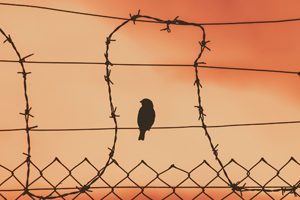 The man who raped me was a broken, wounded human being. The connection I was forced to make by talking to him enabled me to see that. Never mind that it was a connection I made from self-defense. That connection is why I believe I am not consumed with bitterness. It is why I believe in restorative justice, which seeks to return what was taken, restore what was broken, rather than to merely punish, which is the focus of retributive justice.
Healing comes from compassion, and compassion comes from recognizing the humanity of another, says Rosenberg. This is a challenging process, but it can work.
As Gary Zukav says in The Seat of the Soul, we have a choice as to how we react to any situation.2 After any initial and automated response, after we have a chance to truly reflect on a situation, we can seek revenge or embrace compassion. That is our choice.
NO NEED TO TESTIFY
The court case against the man who raped me was only recently resolved –– the wheels of justice indeed turn slowly. As it turned out, I did not have to testify. A plea deal –– one with which I was comfortable –– made testifying unnecessary.
My concern has never been about punishment. I simply wanted the man stopped from hurting women –– I was not the only one –– something the prison sentence he agreed to would prevent.
I heard how he said in court that he was sorry for his actions, that he regretted them. I have no reason to doubt his sincerity.
I chose not to be in the court room the day the judge accepted the plea deal. I knew doing so would do nothing for me. Healing was already mine. My own work over the years brought the closure I needed. And I know my healing is partially rooted in something that happened the morning after the rape.
THE MORNING AFTER
On that summer night in 1987, I sat on my old orange floral loveseat reading the latest issue of Newsweek. I had left the wooden door to my efficiency apartment in the back of a two-story house open to catch any breeze. When I got up to check on an unfamiliar noise, a man yanked the screen door open and jumped into the room. I never saw his face. He wore a ski mask.
Later, after he left me alone laying on my living room floor, after the call to my sister, after the police report, after the trip to the emergency room, my siblings, who all had gotten out of bed to gather around me, decided not to call my seventy-four-year-old father just then. Instead, my two brothers went to Dad’s house in the morning to tell him what had happened. They brought Dad to my sister’s house where I had fallen asleep. When I awoke, I saw Dad standing there and I reached out my hand. He rushed to my side. Crying, he bent his head to touch mine: “Barbie, I am so sorry, so sorry. I love you so much, so much.”
Would I give up that experience of my father’s love pouring out onto me as never before not to have been raped? That is not a question I need to answer. All I know is what happened that night and how my father responded. I accept the one. The other, I embrace, gratefully.
FOR REFLECTION: Have you ever had a bad experience out of which a blessing grew? How did it change your perception of the original experience? Did you find it opening your heart in ways you had not originally considered? Why or why not?
1 Marshall Rosenberg, “Beyond Good & Evil: Marshall Rosenberg on Creating a Nonviolent World,” The Sun (February 2003), 6 & 7, https://fr.nvcwiki.com/images/326_Rosenberg.pdf.
2 Gary Zukav, The Seat of the Soul (New York: Fireside, 1990), 138-39.
Top image: Pixabay/Gerd Altmann
Midtext image: Pixabay/Dimitris Vetsikas
Side image: Pixabay/Avelino Calvar Martinez
