
[God] did not say: You will not be assailed, you will not be belabored, you will not be disquieted, but he said: You will not be overcome. –– Julian of Norwich
Teachers come in all manner of beings. That means sometimes it takes me awhile to recognize them as they come into my life. That certainly was the case with my cottonwood at the back of my yard.
When I bought my house thirty-six years ago, the dominant feature in the back yard was a giant hackberry tree. At least four feet in diameter, it dominated the landscape –– until lightning struck it down. The loss opened my eyes to what I had previously paid little mind to. A cottonwood. A beauty it is own right.
A STRIKE OF LIGHTNING
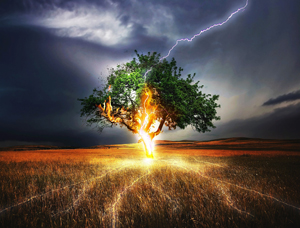
One night, after a phone call from a man who broke my heart, I fell asleep on the floor in my back room where I had been talking to him. During the night, a storm rolled in. I slept through it until a crack of a thunder and a flash of light startled me awake. The next morning, strips of bark were strewn across my deck and yard. They even littered my roof, sheared from the cottonwood that now stood with a ten-foot gash running midway down its trunk. This strike was nothing as severe as what hit the hackberry, but it was significant, and I questioned if it would survive. That was twenty years ago, and the answer is yes, at least, so far, the cottonwood still stands.
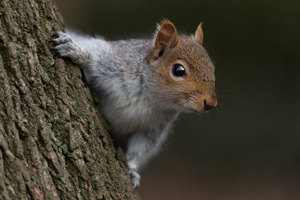 I have watched a mama squirrel drag branches of leaves up the trunk, disappear into the cavity left by the strike. Within two months, I saw young squirrels venturing out onto branches, glad to see them playfully circling the trunk high off the ground.
Wounded though it is, the cottonwood lives and more, providing a space for creatures seeking a home, a sanctuary to raise their young, safe from any predators or storms.
A STORY TO BE TOLD
Over the years, the cottonwood has become a type of avatar for me. I see it as a manifestation of the divine here on Earth, in keeping with the original meaning of the word avatar in Hinduism. I see it as a wisdom teacher of how I am to be, what I can be.
Of course, the cottonwood is not me. It is itself, a wounded one that still stands, holding its place in the ecosystem, cleansing the air, supporting the hillside, providing shelter and shade. I take my lessons where I find them, and certainly this tree has many to give. Its journey is one not only of surviving, but of continuing to contribute what it has to offer the world. It is a story worth knowing.
Barbara Holmes, a wisdom teacher in her own right, writes of the ways “we are revived by the stories that tell us about our reality, our bodies, our spirits, and our God…. They touch us in places that facts seldom reach …
“When I allow myself to succumb to storytelling,” she continues, “I sense connections to others that I seldom notice.… There is a future because the stories are not locked up within our individual lives. Instead, they are held as precious elements of communal wisdom.”1
My cottonwood’s wounds, as my own scars, tell a story of strength, of resilience, of beauty, of what can be overcome. And as the wounds of Jesus told Thomas, the apostle who doubted, “I who was dead am now alive” (John 20:27), wounds can build a better world. Our wounds can create empathy. They say that none of us are alone.
A TRIUMPH
My cottonwood was damaged by an attack, as we all have been in some way or another. No person escapes such wounding. It is almost as if that is as much part of the human condition as hunger, desire, growth, emotion, aspiration, love. We are the wounded, and our calling is to still stand. That does not mean that when knocked down, we don’t take time to grieve, to cry, to rage, to struggle through it all, to even challenge what tore us apart. But ultimately we are called to live. To fight on. To go on. To forgive. To thrive. No less than my cottonwood. No less than myself.
The morning after that heartbreaking phone call, I picked myself up off the floor and went outside. I collected the strips of bark scattered about, then spent the rest of the day working in my yard. I lived into the truth of what an old woman once said to me: “You can bury a lot of troubles in a little plot of land.”
With a trunk a little over two feet in diameter, my cottonwood doesn’t take up much space, but it stands tall. It is a model by which I strive to live. It is a spiritual companion always there, just outside my kitchen window. I not only see it every day, but when I step onto my deck, I can hear it. Its leaves whisper as the breeze moves through them, sharing a message beyond words. And contemplating its meaning, as the cicadas, crickets, and katydids sing, I hear life.
In these fraught times, when so much seems at risk, I take comfort in my tree, in the story of a God that says life always conquers death, that there is always hope, that life goes on. Perhaps not as we will, but simply and surely as it is. And in that is the triumph.
FOR REFLECTION: Think of the hard-won triumphs in your own life. What difficulties or set backs did you need to overcome to achieve as you did? What did you have to let go of? What did you have to accept?
1Barbara A. Holmes, Crisis Contemplation: Healing the Wounded Village (Albuquerque, NM: CAC Publishing, 2021), 110–111, 114.
Top image: Pixbay
Midtext image: Pixabay/Jon Pauling
Side image: Pixabay/Avelino Calvar Martinez
