
 “I hope you are blessed with a heart like a wildflower. Strong enough to rise again after being trampled upon, tough enough to weather the worst of the summer storms, and able to grow and flourish even in the most broken places.” –– Nikita Gill
As I write this dispatch, it’s April 22, Earth Day. And as I do, I recall the first Earth Day 56 years ago when I was a sophomore in high school. Behind my school building was a park where my friends and I ate lunch whenever the weather permitted, sitting on the ground, eating our sandwiches, sharing our chips. That day in 1970, we talked about Earth Day and what it meant.
Originally conceived by peace activist John McConnell at a UNESCO conference in 1969, Earth Day was formalized in the U.S. by Wisconsin Senator Gaylord Nelson in 1970. Today, over one billion people in 193 countries celebrate the day as a sacred time to honor and work for the protection of the only home we human beings have ever known.
It is a day I find resonating with another holy day.
PARALLEL MEANINGS
A little over two weeks ago, Christians around the world celebrated Easter, commemorating the Resurrection of Jesus Christ from the dead. Three days after he was nailed to a cross by the Romans who considered him a threat, he rose. He conquered death, leaving the tomb in which his friends had laid his body. To me, that is what the Resurrection means, that life will always conquer death.
If there is a divine plan, this is it –– in the end, life wins.
And that is the message I find underlying Earth Day. Yes, it is a day to celebrate and emphasize the importance of our beloved planet. After all, where will we live if we have no Earth –– plans to colonize Mars be damned. But Earth Day is also a time to recognize the “wins” in the ongoing efforts to protect our home, even when there seems to be, particularly at this time, three steps backward for each step forward.
FINDING THE HOPE
 Radical Joy for Hard Times is an organization dedicated to finding and creating beauty amid destructions and degradation in our environment, which was founded by Trebbe Johnson. Through her work, Johnson has shown how, even with great destruction of wide swaths of land, life pushes through, like a dandelion coming up through a crack in the sidewalk. Life always finds a way.
“It can be risky to acknowledge that you perceive some compatibility between beauty and annihilation. People want the situation to be unequivocal; one or the other, if you please, not both.…” writes Johnson. “[The] discovery of beauty despite the wound … seems to cancel the severity of the circumstances and offer you comfort…. Suddenly beauty erupts, alights, emerges, illuminates, and you believe that things are going to be all right after all.”1
A SOURCE OF COMFORT
This resilience is where I now find solace, not only from the environmental degradation rampant in our world, but also from our political structures that have fear grabbing hold of so many hearts.
On the environmental level, I think of the trash I pick from the creek behind my house that the rains bring in –– an endless assortment of broken glass, torn plastic bags, and even the occasional child’s toy, a deflated ball or a scuffed Match Box car with a wheel missing. Amid this detritus, I find beauty in the flickering silver of minnows darting through the shallow waters and the Virginia bluebells blooming along the sides.
ERUPTIONS OF BEAUTY
Richard Rohr shows how this eruption of beauty in the natural world can be mirrored, as the Resurrection shows, in our relationships, when he writes: “Resurrection happens every time we love someone even though they were not very loving to us…. Every time we decide to trust and begin again, even after repeated failures, we are resurrected. Every time we refuse to become negative, cynical, or hopeless, we are experiencing … Resurrection.
“Spiritually speaking, we live in a world of abundance, of infinity, but most of us walk around operating in a world of scarcity. And so we hoard it –– Spirit, Love, Life –– to ourselves. We hoard grace and we hoard mercy. We don’t allow ourselves to be conduits through which it pours into the world. Truly, the only way we can hold onto grace, mercy, love, joy –– or any spiritual gift –– is to give them away consciously and intentionally. If we stop acting as a conduit, we lose them ourselves.”2
LOVE CHAINS
So I learn from these wise teachers. The beauty of the Earth is not only found in the lush meadows and sparkling waters, the graceful trees with all its creatures, but in the fact that death of any does not mean the end. That life goes on. It always finds a way. Just as Jesus found a way, by Divine Grace, to come back to life.
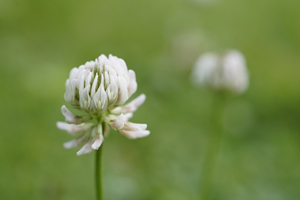
So when I find myself being fearful, worried about what the future could be, I turn to the Earth. I turn to the season of spring, where I find purple and yellow violets dotting my yard, where the seed of Dutch clover I scattered through the lawn last season blooms, reminding me of the chains my friends and I as little girls made of the long stems of its white flowers. Love chains we called them. We wore them around our necks, gave them as gifts to our mothers.
Underneath it all, there exists a chain of love that will not to be conquered, that will not die. And I for one, look to do my part, as Jesus followed his calling, to keep tying those knots in the ways that I can, to work to connect the disparate pieces in an ongoing chain of love.
Just as the Earth keeps bringing forth beauty, I seek to do the same.
FOR REFLECTION: Are you able to see the beauty, the good, where you think there is none. If not, look again.
1 Trebbe Johnson, Radical Joy for Hard Times: Finding Meaning and Making Beauty in Earth’s Broken Places (Berkeley, CA: North Atlantic Books, 2018), 109.
2 Richard Rohr, Daily Meditations, April 10, 2026. https://cac.org/daily-meditations/resurrection-is-possible-now/
Top image: Pixabay/Beauty of Nature
Midtext image: Pixabay/Wolfgang Eckert
Side image: Pixabay/Avelino Calvar Martinez
