
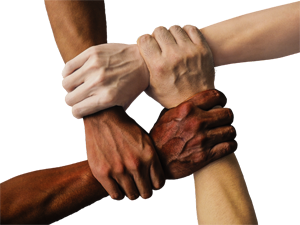
 “I’m touched by the idea that when we do things that are useful and helpful –– collecting these shards of spirituality –– that we may be helping to bring about a healing.” ––Leonard Nimoy
My dear friend, Amari*, is consumed with fear these days. The overt racism in this country is at the root of her fear. She calls me when the actions of one more white supremacist hits the news. She is sure there will be no one there for her if ever she is threatened. She considers buying a gun. Because of the differences in the color of our skin, she thinks that I will always be safe and protected while she will not be.
That racism has no place in this country of ours, I could not agree more. The problem for me during these conversations arises when I begin to feel as if Amari is criticizing me, that somehow, I am responsible for her fear since those spouting heated, hateful rhetoric share the color of my skin.
Once when I said this, she quickly apologized. That is not what she was trying to do.
What is she trying to do, I asked. What am I not understanding?
“I need to know that if ever I am threatened, you will stand up for me, you will protect me,” she said.
“But I have told you before that I would,” I said.
“I need to keep hearing it.”
Tears gathered in the corners of my eyes upon hearing those words. Her words reflected the depth of her fear living in this country, as an immigrant, as a black woman. She fears that someday she may be physically attacked for no other reason than being who she is.
GUILT BY COLOR
Hannah Drake, an African American woman, tells of a trip to the country of Senegal on the radio program, The Moth. While shopping, she and her friend were careful to always have their hands in view as they looked at earrings, as they do in the United States. They did not want the store clerk to think they were trying to shop lift. Turns out, when they went to pay for the earnings they had chosen to buy, the clerk wasn’t even in the store. She was sitting outside enjoying the sunshine. That Drake and her friend would be shoplifters never entered the clerk’s mind.1
My friend John, a white man says, “I think it’s difficult for us white folks to understand what it’s like to be viewed suspiciously almost everywhere we go. I think a lot of black and brown folks feel most of the time as I do walking from (Cincinnati’s) TQL stadium to where we park on Central Avenue (near an inner city neighborhood), where I am out of place and feel unsafe. I can’t imagine what feeling like that most of the time must be like, instead of feeling like that once a month for ten minutes.”
John said he has only experienced discrimination once based on who he is. Although it was a minor incident, he says, “I still vividly recall that incident fifty years later.”
IMMIGRANTS ALL
Amari came to this country legally from Nigeria. She is a naturalized citizen with just as much right to be in this country as I do who was born here. She is brilliant, holds a Ph.D. in biomedical engineering, and is a contributing member to society, using her gifts to serve our community.
(Considering her intellectual prowess, I say that she would be judged as the more valuable immigrant than the poor unskilled German immigrants who were my ancestors.)
This latest round of Amari’s fears was sparked by lies about the good Haitians who live in Springfield, Ohio. The Haitians, who are in this country legally, came to the town at the invitation of city officials and employers to take jobs that had gone begging. The mayor, even the governor, say the Haitians are not guilty of acts of which they are accused.
I was pleased to read how residents of Springfield have reached out to their Haitian neighbors, to reassure them in the face of the bomb threats and terror Neo Nazis had rained down on them. But when I shared this information with Amari, how people are stepping up, it did nothing to calm her fears.
BREAKING THE BOWL
 An experience of mine could serve as a metaphor that explains how I look to move forward. Once, during a meditation exercise, I set out to work with an anger of an unknown source that burned inside of me. I started by focusing on what it was, rather than what I could do with it. It was a dark red ball pulsing with energy. I began to work with that energy, re-shaping it, kneading it, as if it were bread dough. I pushed down, pulled up. Pushed down again. And as I pulled up, I began to see that the energy was taking the shape of a bowl. A very big bowl. Large enough for me.
Later, I realized that while I fit comfortably within the bowl, it was too small for my dreams. When I shared this experience, a friend from my church noted that to bring my dreams to life, “I needed to step outside my bowl.”
I thought these words were wise –– still do. I also believe that stepping out of the bowl was not enough. I needed to break that bowl.
MAKING WHOLE
By breaking the bowl I fashioned out of anger, I am left with pieces that need to be refashioned into a whole. I am left with my brokenness.
Putting my own pieces back together would simply create one more bowl that is too small. What I need to do is to puzzle my broken pieces back together with those of others to create a whole new bowl, much as this country needs a whole new paradigm under which we may unite.
In practical terms, what would that look like? And specifically, what steps am I to take? Can I even play a small part in fixing a land when there is so much brokenness?
Yes.
First, I understand that the answer is not so much the destination, but the journey itself. Part of the journey is to take the time to know the truth –– no easy feat, I know, with mass marketing of misinformation.
Second, I recognize that I can only do a small part. Nothing more. But I am to do my part and use my gifts to serve the common good. For me, that begins with listening –– listening less with my ears and more with my heart. Truly hearing what others are saying without defensiveness. Without projection.
So, having listened to Amari, I understand what is needed. Her needs may change in the months to come. Indeed, I hope they will. But for now, I know she needs reassurance, and that I can give.
Amari, I have your back.
*Not her real name. Other personal details in this dispatch have been changed to protect my friend’s privacy.
FOR REFLECTION: Have you ever been discriminated against? Has your life ever been threatened because of who you are? Can you relate to those who have had such experiences? Why or why not? What are you able to do to heal the wounds resulting from the affliction of prejudice and hatred?
1 https://player.themoth.org/#/?actionType=ADD_AND_PLAY&storyId=24433
Top image: Pixbay/Use at your Ease (truthseeker08)
Midtext image: Unsplash/CHUTTERSNAP
Side image: Pixabay/Avelino Calvar Martinez
